Grand Island Homeowners' Guide to Keeping Gutter Runoff Away from the Foundation
In Grand Island, water rarely arrives politely. A summer thunderstorm can dump a hard burst of rain in minutes, and tropical weather has a way of testing every weak spot around a house. When roof runoff has nowhere smart to go, it tends to find the worst possible place, right along the base of the home. That is where small drainage mistakes turn into soggy mulch, eroded beds, standing water, and the kind of damp conditions that attract pests.
Gutters are not just trim pieces attached to the roofline. When they are planned well, kept clear, and paired with sensible downspout discharge, they help move water off the roof and away from the house in a controlled way. In Florida, that matters more than many homeowners realize. The goal is not only to get rain off the roof. The goal is to keep that water on site in places that can absorb it, like turf, planting beds, rain gardens, rain barrels, cisterns, or other pervious areas, instead of letting it pound the soil next to the foundation.
I have seen plenty of homes where the gutters themselves were not the main problem. The real trouble started three feet lower, where a downspout emptied into a narrow strip of bare soil. Every storm carved a little trench. Every month the mulch washed away. Over time, the wet zone crept closer to the slab and the homeowner kept fixing symptoms instead of the drainage path. That pattern is common, and thankfully, it is fixable.
Start with the real purpose of a gutter system
A gutter system does two jobs at once. First, it catches runoff from the roof edge. Second, it delivers that runoff to a discharge point where the yard can handle it. If either half fails, water control falls apart.
Florida-friendly landscape guidance puts a strong emphasis on reducing stormwater runoff and keeping water on site when possible. That makes good sense around homes in Grand Island. Directing downspouts into lawn or planted areas can reduce runoff and erosion, and it can help keep roof water from collecting where you least want it, near the foundation and around entry walks, patios, or screen enclosures.
This is also where a lot of homeowners get tripped up by gutter myths Florida homeowners hear from neighbors or online threads. One of the most persistent myths is that having gutters automatically solves drainage. It does see details not. A clogged, undersized, poorly sloped, or badly terminated system can still send water right back to the house. Another myth is that any place away from the front door is good enough for discharge. In practice, runoff needs to end in an area that can absorb it without creating erosion or a muddy mess.
Why foundation areas take the hit
The perimeter of the home tends to be the first casualty because roof water concentrates there fast. Without proper control, a broad sheet of rain sliding off a roof gets funneled into narrow drip lines and splash zones. If the grade is tight, if the planting bed is shallow, or if the area has already been compacted by foot traffic, the water lingers.
UF/IFAS guidance notes that runoff can pool near the foundation and create pest issues, which is one of those practical warnings homeowners understand immediately once they have seen it happen. Damp mulch against the house, wet pockets under shrubs, and repeated splashback on lower walls create conditions nobody wants. Even if you never see obvious standing water, repeated saturation in the same zone is a sign the runoff path needs attention.
On many homes, you can spot this from a distance. The mulch under one roof valley looks thinner than the rest. A plant bed shows exposed roots. Soil has washed onto the sidewalk. The grass nearest a downspout looks beaten down while areas ten feet away stay dry. Those are all clues that the water is arriving with force and leaving damage behind.
What “away from the foundation” really means in practice
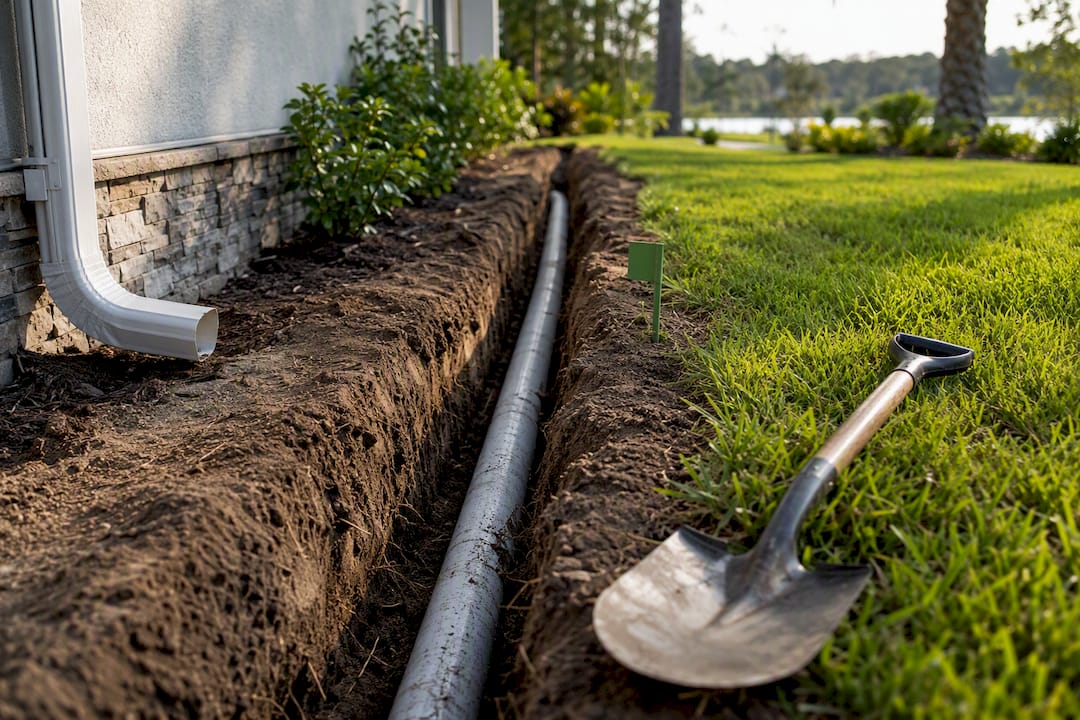
Homeowners often ask where a downspout should send water. The most reliable answer is also the least glamorous: toward a pervious area on your property that can absorb it without washing out. Turf and planted beds are often the easiest targets. In some yards, a rain garden makes sense. In others, a rain barrel or cistern may help capture part of the flow. The exact choice depends on the layout of the lot, but the principle stays the same. Water should move away from the house and toward a place designed to receive it.
That sounds simple, but the yard around the house matters as much as the gutter itself. If a downspout empties into a tiny decorative bed bordered by edging on all sides, the bed can act like a bowl. If it discharges onto a hard surface that tilts back toward the structure, the water can circle right back. If it empties next to bare soil on a slope, it can cut a channel in one wet season.
A better setup usually looks quieter. The downspout sends water into an open lawn area, a broad mulch bed with healthy soil and plant cover, or another pervious zone where the force breaks up and the ground can absorb the flow. It does not have to be complicated to work well.
Roof runoff and the Florida yard need to work together
Florida landscapes are often expected to do too many jobs at once. We want them neat, low maintenance, HOA-friendly, pet-friendly, and able to survive heavy rain. That is exactly why runoff planning should be tied to the landscape instead of treated as a separate issue.
Florida-Friendly Landscaping guidance specifically connects downspouts with stormwater reduction. That is not just a technical point. It means your lawn and planting beds can become part of the drainage solution if they are used thoughtfully. A broad bed with stable mulch and dense roots handles runoff better than a narrow strip of decorative stone. Turf can absorb roof water better than a compacted path. A planted area can soften discharge and reduce erosion when it receives water evenly rather than in a concentrated jet.
This is especially useful in yards with sandy soils, where stormwater can move fast. Sandy ground often drains quickly, but concentrated runoff can still scour the surface before it soaks in. That is why the shape of the receiving area matters. You want room for water to spread and infiltrate, not race downhill.
The pool cage complication
Homes with screened pool enclosures need extra attention. Gutter drainage for pool cages is not just about protecting the foundation. It is also about keeping outdoor living areas usable and clean. UF/IFAS guidance notes that roof runoff and drainage around pool-adjacent spaces should be managed carefully so water does not erode soil or create messy overflows.
Anyone who has dealt with runoff near a pool deck knows the nuisance factor. Soil can wash onto hardscape. Mulch can migrate where it does not belong. Splashing and overflow can turn a tidy backyard into a cleanup project after every big storm. When downspouts discharge near screen walls, corners, or narrow side yards leading to the cage, water tends to concentrate in awkward places.
In those layouts, the best answer is usually not more force, but better direction. The runoff still needs to end in a pervious area, but it should do so without crossing paths with the pool deck or undermining the edges of nearby beds. This is one of those situations where a homeowner has to look at the full route water takes after it leaves the downspout, not just the first two feet.
Maintenance is not optional in Florida
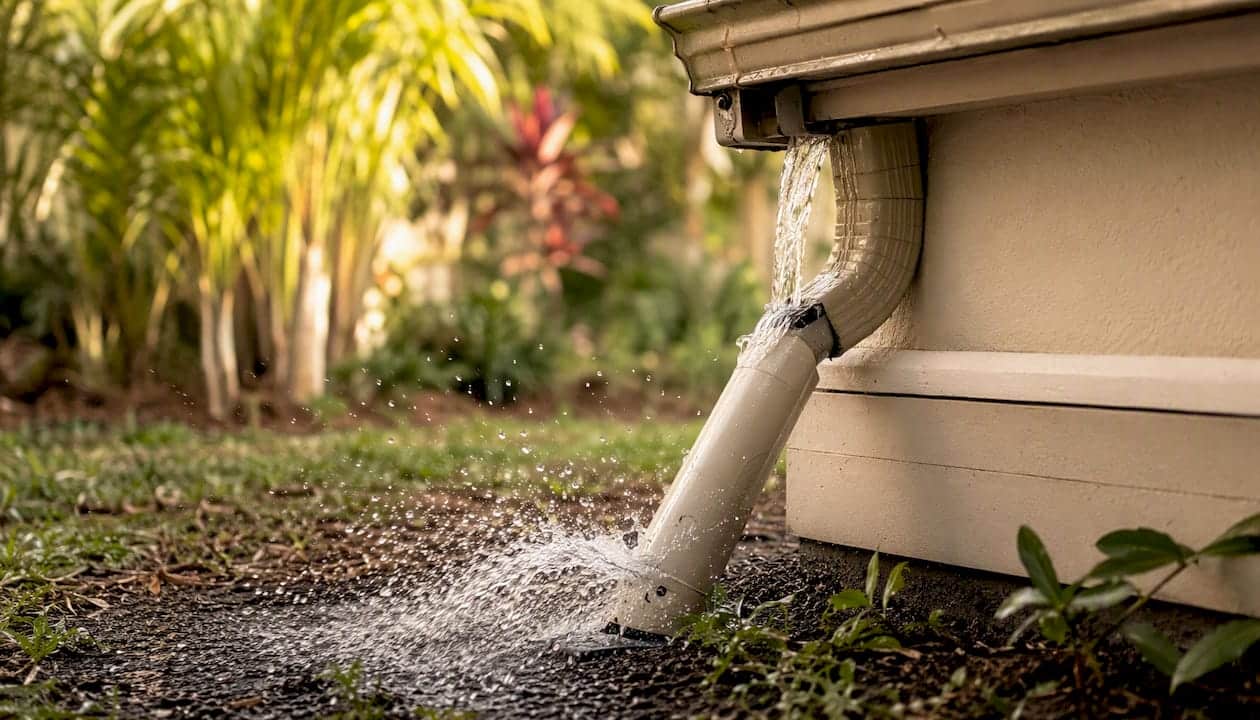
Even a smart layout fails when gutters fill with debris. Florida homes collect leaf litter, twigs, seed pods, and the fine gritty buildup that settles in troughs over time. UF/IFAS materials point out that gutters and downspouts require maintenance because debris can contribute to drainage problems. That is dry wording for a very familiar scene: a thunderstorm hits, the gutter lip overflows, and a sheet of water dumps right where you were trying to prevent it.
If you have ever watched water shoot over the front edge of a clogged gutter, you know how quickly maintenance turns from a minor task into a major one. Overflow near the foundation defeats the whole system. So do packed elbows, loose joints, and downspouts that look open from above but are blocked lower down.
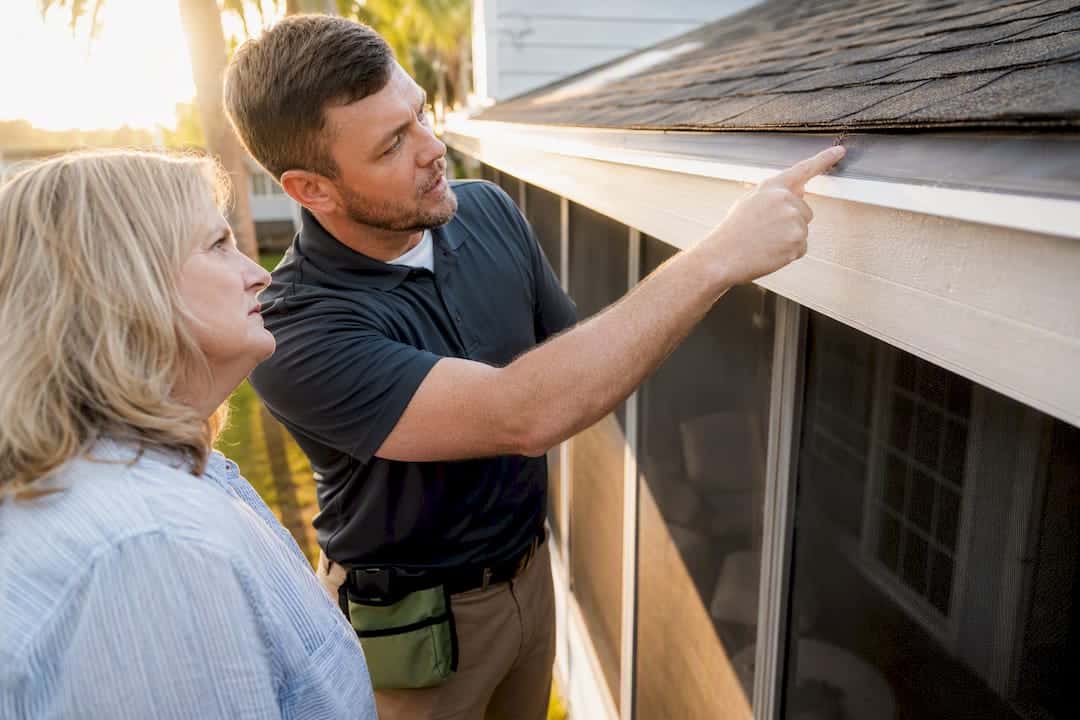
This is where the question of DIY gutter cleaning or hire a pro becomes practical rather than philosophical. If your roofline is low, accessible, and straightforward, some homeowners are comfortable checking and cleaning gutters themselves. If the home is taller, the ladder setup is awkward, the roof edges are harder to reach, or the system has recurring problems, hiring a pro is often the better call. Clean gutters are useful. Safe cleaning matters too.
The same local service searches show what homeowners worry about most: gutter cleaning Dunnellon FL, gutter repair Hawthorne FL, gutter guards Mount Dora FL, seamless gutters Williston FL. The town names vary, but the concerns are consistent across Florida. People want systems that handle rain, match the house, and do not become a constant maintenance headache.
A year-round gutter checklist Florida homeowners can actually use
Seasonal care does not need to be elaborate. The trick is to check the system often enough that problems stay small.
- Look at gutters and downspouts before the summer rainy stretch and again after major storms.
- Clear leaves, twigs, and packed debris so water can move freely through the trough and downspout.
- Watch where each downspout discharges, and make sure the receiving area is still stable, pervious, and not eroding.
- Check for overflow marks, washed-out mulch, or soil movement near the foundation and around pool areas.
- Address loose sections or obvious damage promptly, because small failures tend to show up first during the next hard rain.
That short routine catches most of the issues that cause foundation-area runoff problems. It also helps you see the difference between a clog problem and a discharge-location problem, which are often mistaken for each other.
When gutter guards help, and when they do not
Gutter guards are appealing because they promise less cleaning, and for some homes they can reduce the amount of leaf litter entering the system. That said, they are not a magic shield. Debris can still collect on top of guards, finer material can still get through, and downspouts still need to move water efficiently.
Homeowners shopping for gutter guards Mount Dora FL or nearby often assume guards eliminate maintenance entirely. In real life, they change the maintenance pattern more than they erase it. That can still be worthwhile, especially where nearby trees constantly drop debris, but it helps to go in with reasonable expectations. A guarded system still needs periodic inspection, particularly before and during the wettest parts of the year.
The more important question is whether guards support the bigger drainage plan. A guard that slightly improves debris control is helpful. A clean gutter that still dumps water into a bad location is only half-fixed.
Choosing gutters for the house you actually have
Some gutter decisions are functional first, while others affect curb appeal and neighborhood approval. Both matter, but function should lead.
Homeowners with metal roofing often ask about gutters for metal roofs Florida homes. The main issue is not style alone. It is making sure the roof runoff is captured and directed where it needs to go. Metal roofs can shed water efficiently, so the path from roof edge to discharge area needs to be thought through just as carefully as with any other roof type. The gutter system has to match the roofline and the property’s drainage realities.
Then there is color. Gutter colors for Florida homes come up more than people expect, partly because gutters are highly visible and partly because some neighborhoods care a lot about exterior consistency. Florida HOA law gives associations authority over exterior appearance standards, including color and style specifications for certain exterior products, but those standards must still comply with building code requirements and cannot be used to deny conforming installations. In practical terms, that means homeowners should check design requirements early, especially if they live in an HOA community, but appearance rules do not override code-compliant needs.
For many homes, a color that blends with fascia or trim keeps the visual line clean. That is not a drainage issue, but it does matter when homeowners want a system they will be happy to keep for years.
What affects gutter installation decisions
A lot of people begin with the question of gutter installation cost factors Florida homes face, and that is understandable. Cost matters. Still, a cheaper system that sends water to the wrong place is not a bargain.
The real cost factors are usually tied to the shape and complexity of the roofline, the number and placement of downspouts, the accessibility of the home, and whether the discharge areas are ready to handle runoff properly. A simple rectangular roof edge is one thing. A house with multiple corners, transitions, and tight landscape zones around the perimeter is another. If the drainage path needs rethinking to protect beds, lawn, or pool-adjacent areas, that deserves attention before installation day.
Seamless gutters Williston FL is another phrase homeowners often search because it signals a preference for a cleaner-looking system with fewer joints. Without getting into claims that go beyond the verified facts here, it is fair to say that homeowners usually weigh appearance, maintenance expectations, and fit along the roofline when considering different gutter setups. Whatever system is chosen, the non-negotiable part is that it must direct runoff away from the home and toward pervious areas that can absorb it.
The warning signs that tell you runoff is missing the mark
Most drainage problems announce themselves well before they become severe. The challenge is noticing them for what they are. Homeowners often treat them as isolated yard problems when they are really gutter discharge problems.
- Mulch repeatedly washes away in the same bed.
- Soil is eroding beneath a downspout or along the side of the house.
- Water pools near the foundation after storms.
- Outdoor areas near the pool cage or patio get muddy or messy after roof runoff hits.
- You see overflow from the gutter edge during rain, even though the downspout area looks dry.
That last point is especially telling. If the gutter is overflowing at the top, the issue may be debris or a blocked path. If the gutter flows fine but the ground below keeps washing out, the issue is more likely where the water ends up.
Repair first, then refine
Some homeowners want to jump straight to upgrades, but basic repair often comes first. Loose sections, disconnected downspouts, and obvious drainage failures need correction before you can judge whether the layout is sound. Searches like gutter repair Hawthorne FL reflect that reality. Repair is not glamorous, but it is the foundation of every smarter runoff plan.
Once the system is actually carrying water the way it should, then you can observe performance during a hard rain. That is the best test there is. Stand back and watch. Does the water stay inside the gutter? Does it exit cleanly through the downspout? Does the yard absorb it without washout? Does it stay out of the foundation zone? Those observations are often more useful than any guess made on a sunny afternoon.
I usually tell homeowners that one honest rainstorm can teach you more about your drainage than three contractor visits if you know what to look for. The clues are visible. You just need to watch the entire route from roof edge to final landing spot.
The small decisions that make a big difference
What separates a frustrating system from a reliable one is often a set of ordinary choices. Keeping discharge in a pervious area instead of onto a hard surface. Protecting planted beds from concentrated flow. Checking gutters before the wet season instead of after damage appears. Fixing a loose component before the next heavy storm. Making sure pool-adjacent runoff does not create erosion and mess.
None of that sounds dramatic, but those are the habits that keep water where it belongs. In Grand Island, with the kind of weather Florida delivers, roof runoff needs a plan. Gutters are part of that plan, not the whole of it. The whole system includes the roof edge, the downspout path, the lawn or planting bed that receives the water, and the routine care that keeps everything open and working.
When those parts line up, the house stays drier at the base, the yard holds together better, and storms become less of a cleanup event. That is really the point. Not perfection, just control. Enough control that a heavy Florida rain does not turn into a foundation problem waiting to happen.